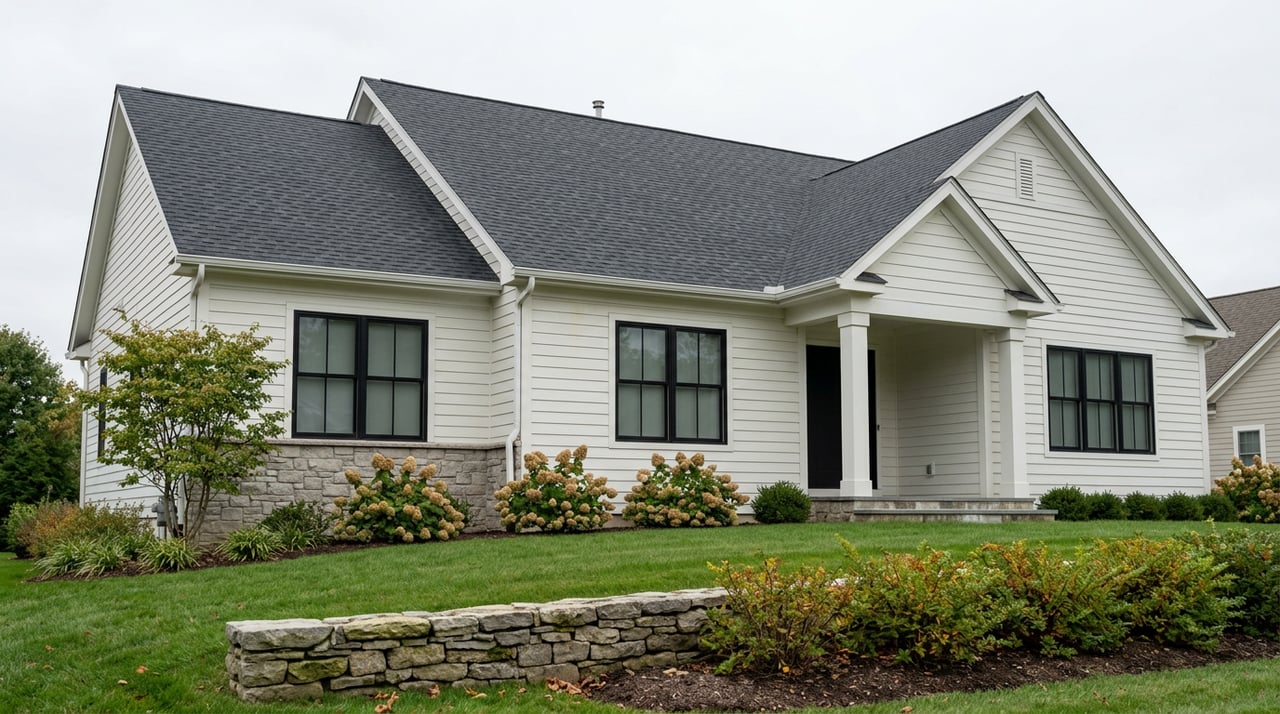
Two houses go up for sale within the same week, both listed as "Brevard, NC," both asking close to $450,000, both roughly the same size and age. A buyer touring both assumes the carrying costs will be close too. They won't be. One of those houses might carry a single county tax bill. The other might carry two bills mailed from two different offices, and if it happens to sit inside a specific sixteen-block stretch of downtown, a third charge on top of that. Nothing on the listing sheet tells you which house is which.
This isn't a hypothetical quirk. It's how Brevard's tax structure actually works, and it's the kind of detail that only shows up once you've closed and opened your first tax bill, which is exactly the wrong time to learn it.
Three Different Tax Realities, One Town Name
Most of what people call "Brevard" sits outside the incorporated city limits, in unincorporated Transylvania County. Those properties owe one tax bill: the county rate, full stop. But a meaningful share of homes and businesses sit inside the actual City of Brevard boundary, and for those owners, the county bill is only half the story.
Starting with the 2019 tax bills, the City of Brevard began collecting its own municipal tax separately from the county, which means anyone inside city limits gets two bills each year rather than one, one from Transylvania County and one from the City itself. The county's tax administration office confirms the same arrangement on its own site: properties inside these districts receive one bill from the county and a second from the city.
Then there's a third layer that applies to an even smaller footprint. A compact core of downtown, organized as the Heart of Brevard Municipal Service District, carries an additional special assessment on top of both the county and city bills. This isn't a homeowners association fee or a voluntary merchant contribution. It's a tax district with its own staff and governing board, funded by a targeted levy on the properties inside its boundary, plus a contribution from the city's general fund, plus private investment layered on top. The money goes toward the visible texture of downtown: streetscape work, building renovation support, the kind of steady upkeep that keeps a sixteen-block core looking the way visitors expect it to look.
So depending on exactly where a parcel sits, "Brevard" can mean one bill, two bills, or three. None of that distinction shows up in a property's mailing address, and very little of it shows up on a standard MLS printout.
| Location | Who bills you | What it funds |
|---|---|---|
| Unincorporated Transylvania County | County only | General county services, schools, county roads |
| Inside Brevard city limits | County + City | County services plus city police, fire, streets, stormwater |
| Inside the Heart of Brevard district | County + City + MSD | Everything above, plus downtown streetscape and district-specific improvements |
Why A Lower Rate Doesn't Mean A Lower Bill
Here's where the timing gets genuinely confusing for anyone comparing tax history across two Brevard listings right now. Transylvania County went through a countywide reappraisal in 2025, bringing every property to 100% of market value as of January 1, 2025, using sales from 2021 through 2024 to set the new figures. As a direct result, the county's tax rate itself dropped substantially, from roughly 0.6033 per $100 of value in the prior several years down to 0.4105 for the 2025-26 tax year, according to the state's own published county rate schedule.
If you're only looking at the rate, that reads like a tax cut. It isn't necessarily one. A reappraisal resets the denominator, not just the rate. Property values across the county moved up, in many cases substantially, and the lower rate is applied against that higher base. A seller's most recent tax bill, printed before the reappraisal took full effect, can understate what a buyer will actually owe once the new assessed value and new rate both apply to a sale that closes this year. Anyone pricing carrying costs off a seller's old tax history in Brevard right now is working from a number that's already out of date.
The Sixteen Blocks Carrying The Extra Layer
The Heart of Brevard district deserves its own mention because it's easy to assume a Municipal Service District is just another name for an HOA, and it isn't. An HOA is a private contract you opt into by buying inside a subdivision. A Municipal Service District is a public taxing authority created by the city, with its own board overseeing where the money goes.
What that money buys is specific and visible if you know where to look: the renovation of buildings along the district's core streets, ongoing streetscape improvements, and the general maintenance that keeps downtown Brevard's commercial spine looking cared for year after year. A property inside this footprint isn't paying for a golf course or a private amenity. It's paying, on top of city and county tax, for the upkeep of the exact blocks that make downtown Brevard's dining and shopping district function the way visitors and residents both expect.
For a buyer evaluating a downtown condo or a commercial storefront, that third layer is a real and permanent cost of the location. For a buyer eyeing a quieter address two miles out, none of it applies, and the value proposition on offer is correspondingly different.
What This Means When You're Actually Comparing Two Listings
Current pricing makes the stakes worth spelling out. Zillow's home value index for Brevard stood at $464,538 as of July 2026, down 2.0 percent from a year earlier. A separate market tracker put the median sale price at $569,000 for homes that closed in May 2026, with a typical marketing period of 103 days. Those two figures measure different things, an estimated value index versus an actual sale-price median, and they will rarely match exactly. But both point to a market where a difference of one or two tax layers on a $450,000 to $550,000 home is not a rounding error. It's a real, recurring number that changes the total cost of owning that specific address versus one a short drive away.
Before you write an offer on anything marketed as "Brevard, NC," it's worth asking a short list of questions the listing sheet won't answer on its own:
- Is this parcel inside the City of Brevard's limits, or in unincorporated Transylvania County?
- If it's inside city limits, is it also inside the Heart of Brevard Municipal Service District boundary?
- What was the seller's most recent tax bill based on, the pre-reappraisal value or the 2025 reassessed value?
- Does the seller's tax history reflect one bill, two, or three?
Your closing attorney and the Transylvania County tax office can confirm all of this before you're under contract, not after.
A Few Questions We Hear Often
Does every home in downtown Brevard pay the Heart of Brevard tax? No. The district has a defined footprint of roughly sixteen blocks. A downtown-adjacent property just outside that boundary can be inside city limits without carrying the MSD assessment.
If I buy just outside city limits, do I lose access to city services? Not necessarily to everything, but city-provided services like police coverage, city fire response, and the city's stormwater program are tied to the incorporated boundary. Unincorporated properties rely on county-level equivalents instead.
How do I find out which taxing districts apply to a specific address before I make an offer? The Transylvania County Tax Administration office and the City of Brevard's tax collection office can both confirm a parcel's status directly, and it's a five-minute phone call worth making before you get emotionally attached to a listing.
If you're weighing two Brevard addresses that look identical on paper and want someone to check what's actually attached to each one before you write an offer, Mountain Real Estate Rocks can walk the tax history, the district lines, and the comps with you. Find Your Mountain Home starts with knowing exactly what you're buying into.